
Appearance
Recipes
Small, complete walkthroughs of Mapping setups for common scenarios. Each recipe teaches a specific pattern — what entities to create, what definitions to write, what workflows to configure.
Recipes are concrete. They use specific entity names, column lists, and step lists. Adapt the names to your project; keep the structure.
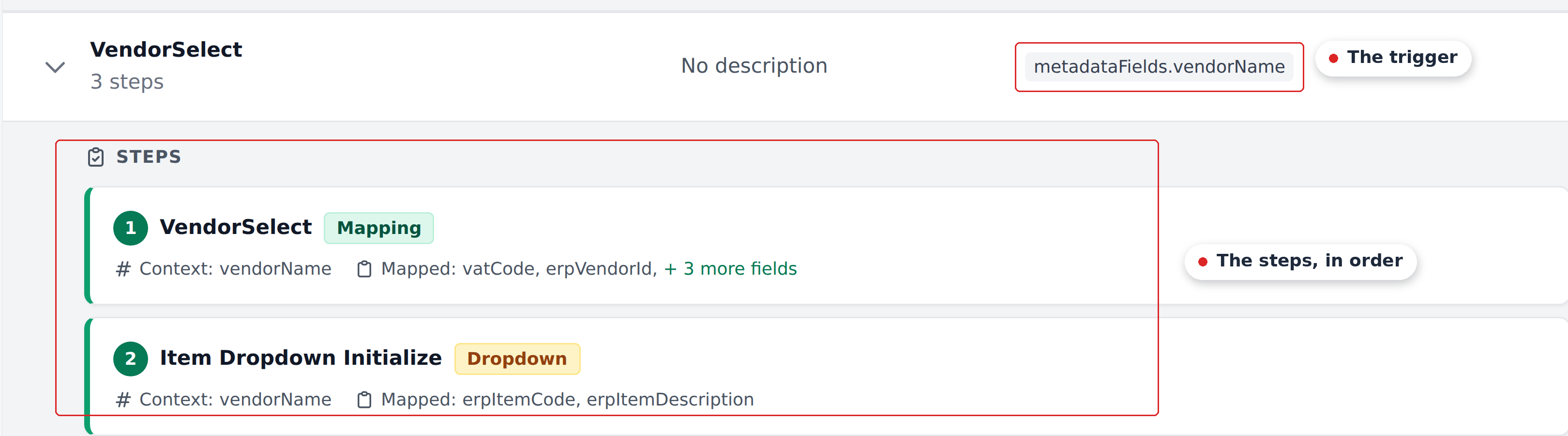
Each one ends up looking like this — a workflow with a trigger and an ordered set of lookups.
What's in this section
Three starter recipes:
- Adding a new vendor mid-review — what an assignee does when a document arrives with a vendor that isn't in the Vendors entity yet. Teaches: Entities, Reset Data, the empty-cell rule, the Initial Workflow re-run.
- Routing approvals by invoice total — a workflow that routes Group 1 if total is under €10k, Group 2 if under €50k, Group 3 otherwise. Teaches: Matching Types (Less Than / More Than), multi-rule workflows, the conditionality-at-workflow-level rule, the
approvers_N_Mfield convention. - Serving multiple companies from one project — the discriminator pattern. One project handles invoices for several subsidiaries, with entities shared across all of them and a per-document discriminator narrowing every lookup. Teaches: composite-key matching with pure AND, multi-tenancy without per-tenant duplication.
How to read a recipe
Each recipe is structured roughly like this:
- The problem. What scenario the recipe addresses.
- The entities. What tables you need and what columns.
- The definitions. The lookup rules and their Context/Mapped configurations.
- The workflows. Which workflows invoke the definitions and in what order.
- A walkthrough. A specific document going through the configuration end-to-end.
- What this teaches. The general lesson — how the same pattern composes in other scenarios.
Read top to bottom for a first pass. Skim back to the specific section when you're implementing.
When recipes earn their place
Recipes are most useful when:
- You're new to Mapping and want to see what a real configuration looks like.
- You've got the basics down but want to confirm a pattern before committing to it.
- You're debugging and want to compare your config to a known-good shape.
Recipes don't replace the reference docs. They show specific patterns; the reference covers the full design space. Use them together.
More recipes coming
The starter set above is intentionally small — three recipes that cover the most common patterns. More recipes will be added as customer feedback identifies the next-most-useful patterns. If there's a scenario you'd like covered, talk to your account manager or contact Recognito support.
What's next
- Adding a new vendor mid-review — start here if you're new.
- Routing approvals by invoice total — the canonical conditional-routing example.
- Serving multiple companies from one project — for multi-tenant projects.