
Appearance
Concepts overview
The vocabulary you need to read any other page in this section. Five core ideas — matching types, cascade behavior, fallback records, async settling, the empty-cell rule. Read once, refer back as needed.
Each idea has its own page; this one is the index plus a short orientation to where each idea fits.
All five show up in one place — a workflow row with its trigger and its ordered steps.
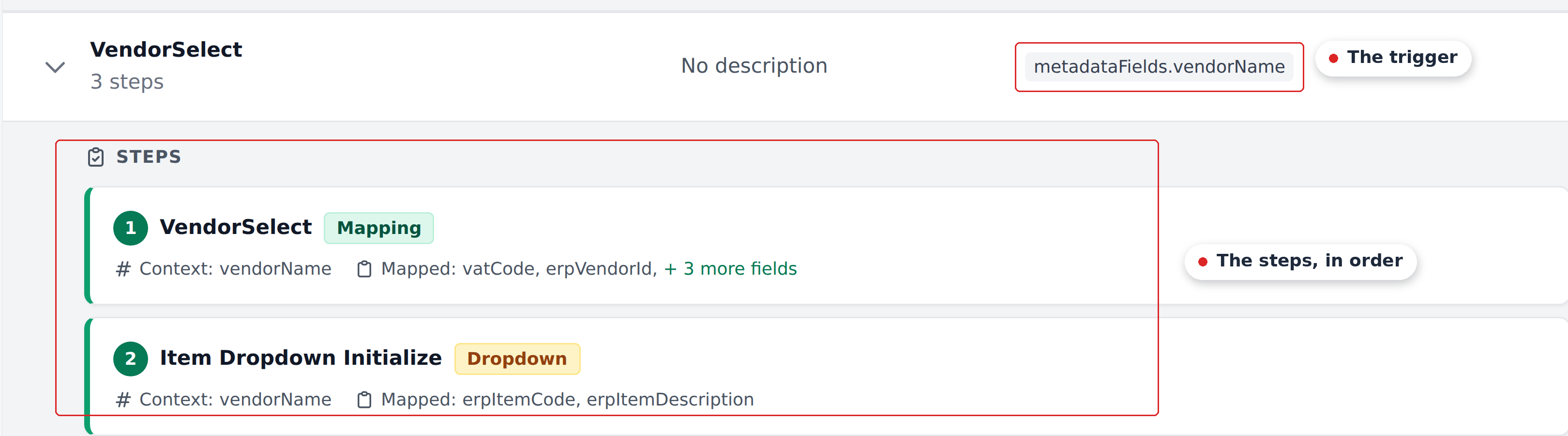
The five ideas
Matching types
Define how each Context column compares against entity data. Five options: Exact, Less Than, Less Than or Equal, More Than, More Than or Equal. Each Context column gets its own Matching Type.
Combined across Context columns with pure AND, matching types are how range routing, conditional logic, and composite lookups work. There are no comparison operators inside column values — every conditionality is expressed through Matching Type composition.
Cascade behavior
How writes flow inside a workflow. Each step in a workflow's chain runs in order; later steps see writes from earlier steps. This sequential feed-through is how composite lookups work.
The crucial constraint: workflows do not trigger other workflows. Cascade happens inside one workflow, not across them. Multi-step logic lives in one workflow's step list.
Fallback records
What happens when a Mapping lookup finds no full match. An applicable fallback or existing default row can supply values; otherwise the mapped lookup leaves its fields unchanged.
For document-level Mapping Context, Level 0 covers a first-column miss. Level 1 covers a later mismatch and selects defaults for the first Context value. There are two levels, and they do not fall through.
Async settling
When a workflow fires, its steps run server-side and the affected fields update in the UI together once the network response arrives. The typical settle time is 1–2 seconds. During the settle, the trigger field shows its new value but the other writes haven't arrived yet.
This matters for API consumers polling the document, for automated tests, and for understanding what reviewers see during edits.
The empty-cell rule
When a matched entity row has an empty cell for a Mapped column, the document field is not overwritten. Empty cells in entities never overwrite document data.
This is consistent with intent: customers populate as much as they know about each row, and the engine writes only the known parts. Customers don't have to fill every cell of every row.
How the concepts compose
These five ideas are entangled — most real configurations touch all of them.
A typical Mapping step:
- Matching Types decide which entity row matches.
- Cascade behavior decides what other steps see.
- Empty cells decide which writes happen.
- Fallbacks decide what happens if nothing matches.
- Async settling decides when the UI shows the result.
You don't have to memorize all five before configuring anything. Most setup walks them naturally — but knowing the names ahead of time helps when you hit edge cases.
What's next
- Matching types — the operators on Context columns. Start here.
- The empty-cell rule — one short page; touches everything else.
- Cascade behavior — how writes flow inside a workflow.
- Entities overview — once you've got the concepts, move to the concrete pieces.